How AI Made Me a Better Psychologist

Every AI-in-healthcare pitch eventually comes down to the same promise: get your evenings back. Stop typing notes at 9pm. Reclaim your weekends. And Ecko is no different; we use this pitch, too. But I've read enough of these to start picturing a stock photo of someone closing a laptop and walking, unhurried, toward a sunset holding a margarita while wearing a sombrero.
It's not wrong, exactly. Documentation genuinely does eat into time that should belong to us. But if I'm honest, the time-saving pitch was never what hit home for me personally. After working with my Clinical Twin for a while, what ended up mattering was something else entirely, something well beyond what I’d expect from an AI scribe.
At some point, I noticed my session notes got better. The kind of better where I can open a file from four months ago and actually reconstruct what happened, not just see that something happened. Anyone who has tried to decipher their own handwriting from a Friday afternoon session, five clients deep, knows this is not a trivial win. My notes used to be a private code even I sometimes couldn't crack. Now they're something I'm genuinely comfortable handing to another clinician picking up the case.
Or, to a lawyer after receiving a subpoena.
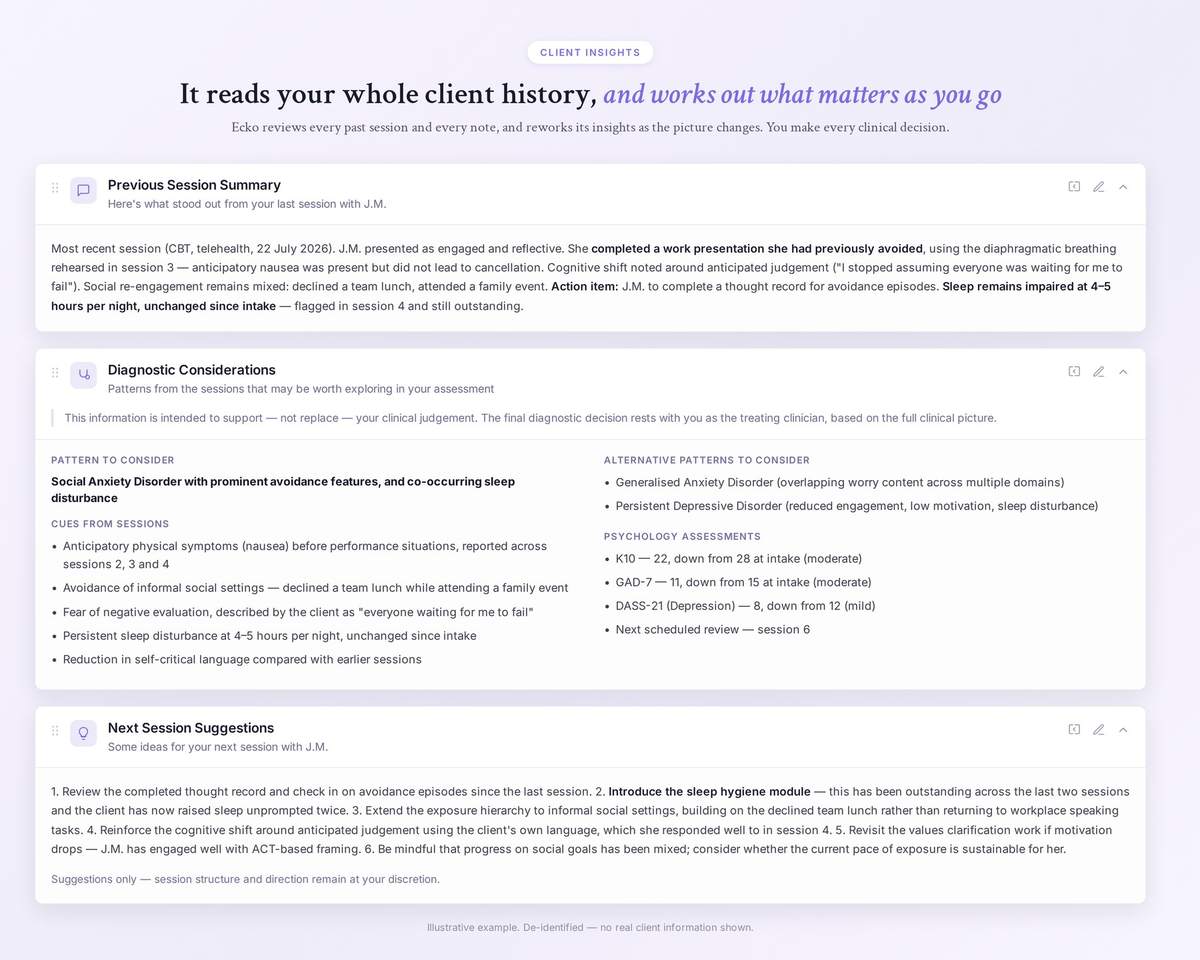
Preparation improved, too, in a way I didn't expect. Walking into a session having been briefed by AI that gives me the history and arc of someone's care means I’m no longer skimming my own sometimes cryptic stream of consciousness typed out in a single-paragraph note, which was apparently my summary of the previous session. It means I’m ready to go immediately with more background knowledge than I retained previously. Clients notice when you remember the detail they mentioned in passing three weeks ago. It reads as care, because it is care; it's just care that used to depend on my memory holding up on a Friday afternoon after six sessions, which, generously, it does not always do. (Don’t know if that’s the margarita talking …)
Then there's the resources. I used to have a small, well-worn rotation of handouts and psychoeducation sheets I'd reach for again and again, because building something new and properly tailored took time I rarely had between clients. And trawling through the garbage on the Internet to find something useful and clinically meaningful was frustrating, often futile. Now I can put together something genuinely specific to the person in front of me: their language, their situation, their goals, using the clinical context the platform already has, quicker than it used to take me to find the right generic PDF. It's a small thing that isn't small at all when you're the one receiving a resource that actually sounds like it was written for you.
But here's the one that matters most to me, and it's the hardest to put a number on: I’m simply more present in the room. Not taking notes while someone is telling me something difficult. Not doing that thing where part of your brain is composing a sentence for later while the rest of you is supposedly listening. Just listening. Maybe a fair amount of my clinical attention had quietly been rented out to note-taking for years, and I only noticed once I got it back.
None of this has replaced my clinical judgment, and it shouldn't. The Clinical Twin provides a first draft of a session note or report. It’s never a final draft; I decide if it's right. It can hand me a well-organised session history, and using context across the broader case, it can even suggest ideas for my consideration. But it doesn't prescribe what I should think. That distinction matters more in our field than almost any other, and it's worth being clear-eyed about it rather than letting the tech quietly drift into doing the thinking for us.
I’m the human-in-the-loop. I’m the one in charge.
I’m best positioned to make clinical judgments about my clients. I can see their mannerisms. I can hear their intonations. I can sense their emotions. (Plus, I’m a control freak, so no AI tool is ever going to make important decisions for me.) Also, when those observations matter, I can share them with the AI so they become part of the context it carries forward into future sessions.
So, when people ask me what AI has actually changed about my practice, I've stopped leading with the time savings, even though they're real (and I know the Ecko marketing department likes to use this tagline, too). What I tell them is this: the paperwork got better, the prep got better, the resources got better, and, somewhat to my surprise, so did I, as the person actually sitting across from a client. That is a harder thing to put in a marketing brochure than "get your evenings back." It's also, for me, the truer story. I’m just a better clinician now than I used to be. (And that’s not the margarita talking.)